
New research suggests that the right kind of celebration could actually add healthy years to your life, acting almost like a social prescription. Yet the same work also points out that not every night out qualifies, and that many of our gatherings miss one crucial ingredient.
The surprising science behind “healthy” partying
The idea sounds almost too convenient: go out, have fun, live longer. But the researchers behind a study from Indiana University and partner institutions are not talking about binge drinking or chaotic nights that end in regret.
They looked at structured celebrations and how these affect mental health and, in the long run, life expectancy. Their conclusion: parties can act as powerful social rituals that reduce anxiety, stabilise mood and strengthen the feeling that you’re not alone when life gets rough.
Under specific conditions, collective celebrations can work like a protective factor against stress, loneliness and poor mental health.
Those mental-health gains matter, because long-term studies consistently show that strong social ties are linked to lower risks of early death, heart disease and even cognitive decline. A party, in this context, is not just a fun break. It’s a way of feeding the social networks that keep us mentally and physically resilient.
The three-part recipe for a life-extending party
The team behind the study describe a simple three-part formula that separates a random night out from a genuinely health-boosting celebration. Their work, published in the Journal of Public Policy & Marketing, suggests you need all three elements, not just one or two.
- People coming together, physically or virtually
- Food and drinks shared in some form
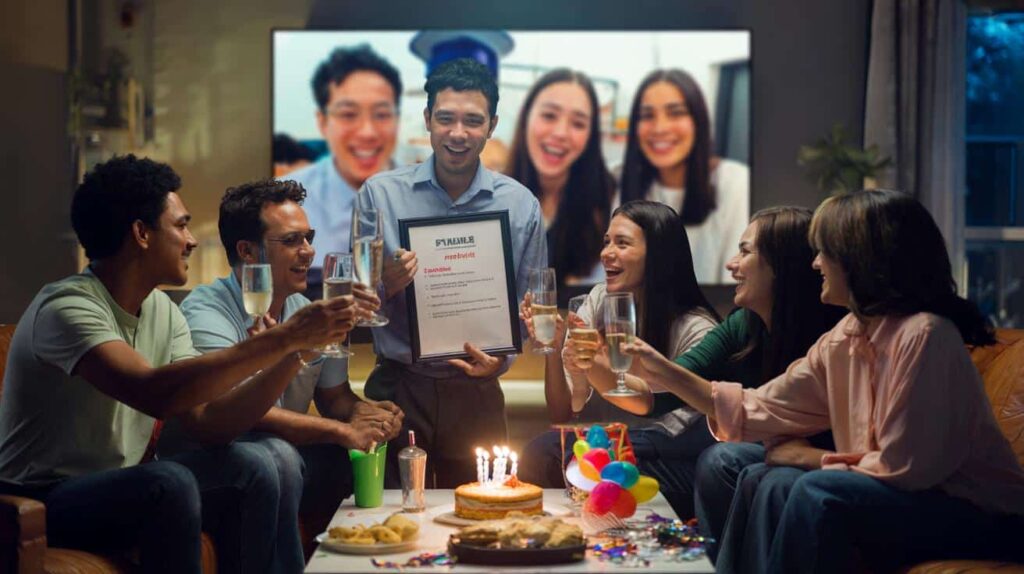
- A positive event clearly marked and celebrated
At first glance, that sounds almost trivial: of course parties involve people, snacks and a reason to celebrate. But when researchers dug into real-life examples, they found that many gatherings fall short, especially on the “positive event” side.
Birthdays, job promotions, exam results, the launch of a side project, even completing a punishing video game level: all these moments can become life-affirming events. Yet groups often drift into small talk, complaints and gossip, barely spending a minute acknowledging what they supposedly came together for.
Parties that clearly spotlight a shared success or someone’s achievement tend to generate stronger feelings of support and belonging.
That feeling has a technical name: perceived social support. It’s the belief that other people would stand by you if things went wrong. Studies show that this perception alone, even before anything bad happens, predicts lower rates of depression and anxiety and better long-term health.
Why praising others might be your biggest health “buff”
The most striking part of the research is not the presence of cake or cocktails. It’s the focus on other people’s wins. According to the authors, many gatherings already tick two boxes: people meet up, and they share food and drink. The missing piece is often a genuine moment of recognition for someone else.
In other words, the healthiest parties are not centred on talking about yourself. They revolve around lifting up the group, one person at a time.
A deliberate effort to celebrate another person’s success appears to boost the wellbeing of both the person praised and the people doing the praising.
The data suggest that when you congratulate a friend on their new job, or cheer a sibling who finally graduated, you’re not just being polite. You’re strengthening your own sense of connection. That sense of belonging creates a buffer against stress, social isolation and the late-night thought spiral that fuels anxiety.
The researchers describe a kind of virtuous circle: people who feel supported are more likely to keep showing up, to stay in touch and to be present for others. That, in turn, keeps the network strong and the health benefits flowing across the group.
What a “healthier” celebration actually looks like
To picture how this works in everyday life, imagine two Saturday nights with the same people:
| Typical night out | Protective celebration |
|---|---|
| Drinks at a bar, mostly small talk and complaints about work. | Small gathering where everyone raises a glass to a friend’s new role. |
| Phone scrolling, scattered conversations, no real focus. | Specific moment in the evening to share recent wins, big or small. |
| People leave feeling tired and slightly disconnected. | Guests leave feeling seen, valued and less alone. |
The researchers argue that the second version, repeated over months and years, can subtly tilt the odds towards better mental health and a longer, healthier life.
Virtual parties still count – with the right ingredients
The study doesn’t only apply to crowded living rooms or busy pubs. Collaborations with researchers from the University of Connecticut and Duke University looked at online gatherings too.
The message is simple: the brain seems less fussy about location than we might think. Video calls, gaming sessions on Discord, or shared watch parties can still deliver strong psychological benefits, as long as they keep that three-part structure.
If people eat or drink together, even through a screen, and mark a positive event, the mental-health gains look very similar to in-person celebrations.
One example the researchers give is a remote toast for a friend’s promotion while everyone eats the same takeaway. Another is a gaming group ordering pizza from their own cities to celebrate finally beating a long-running challenge. The distance matters less than the shared focus and emotional connection.
Social rituals in an age of isolation
These findings land at a time when social isolation is being described by public health bodies as a risk comparable to smoking. Loneliness has been linked to higher blood pressure, poorer sleep and increased inflammation, all of which shorten lives.
Against that backdrop, the idea of deliberately turning milestones into shared, emotionally rich rituals looks less like a luxury and more like a preventive measure. Regular, meaningful gatherings might not show up on a blood test, but the effects seem to trickle through the body all the same.
The catch: when partying stops helping and starts hurting
There is, of course, a limit. The study focuses on celebrations as social structures, not on heavy drinking or all-night clubbing as such. Alcohol still carries very real risks that grow with each unit consumed: liver disease, accidents, sleep disruption, and some cancers.
So a “healthier” party is less about bottomless shots and more about intention and moderation. The researchers’ model works just as well with sparkling water, mocktails or tea. The real medicine is connection, not ethanol.
Public health data also show that people who drink heavily to cope with stress or sadness usually see their mental health worsen over time. That runs against the whole point of these celebrations, which is to reduce anxiety and lift mood in a stable, sustainable way.
Making your next party better for your future self
Translating the research into practice doesn’t require a psychology degree. It mostly requires planning a few minutes of genuine attention into your next gathering.
- Pick a clear reason to celebrate, even if it feels small.
- Set aside a moment where everyone acknowledges it out loud.
- Invite people who actually care about each other, not just warm bodies.
- Keep alcohol at a level where people still remember what was said.
- For online events, eat or drink together on camera to mimic sharing a table.
Those small tweaks turn a casual meet-up into something closer to a ritual. Over time, repeated rituals signal to your brain that you’re part of a stable group. That signal lowers the background “threat level” in your nervous system, making stressful events feel more manageable.
Why psychologists care about “perceived social support”
One key concept sitting behind this research is perceived social support. This doesn’t just measure how many people you know. It looks at your belief that those people would actually step in if you needed them.
Regular, meaningful celebrations keep that belief fresh. Every time someone turns up for your birthday, raises a glass to your new qualification, or shouts you out in front of others, your brain collects data: “These people have my back.” That belief calms the body’s stress systems, including hormones like cortisol.
Researchers have found that people with high perceived social support tend to recover faster from illness and are less likely to develop some chronic conditions. The mechanism is indirect but consistent: lower stress, better sleep, healthier behaviours and more reasons to keep looking after yourself.
Where this leads: from parties to everyday habits
You don’t need a packed calendar of big events to gain some of these advantages. The same principles can be woven into quieter routines. A weekly family dinner that always includes a “what went well this week” round. A monthly online catch-up with old colleagues where one person’s progress takes centre stage. A regular game night where achievements at work or study are part of the conversation, not an awkward side note.
These moments help anchor people in something larger than their private worries. Over years, that sense of belonging may matter more for longevity than any single New Year’s Eve party, no matter how memorable the fireworks were.