
On a damp April morning, I watched my neighbor Lena stare at her vegetable beds like someone waiting for test results. Her tomato seedlings were pale, the spinach looked tired, and the fertilizer bag in her hand promised miracles she could barely afford. The soil looked dull, almost lifeless, as if the whole garden had exhaled and run out of breath.
Yet a few meters away, in a forgotten corner where nobody ever bothered to dig, wild nettles and clover were exploding with energy. Deep green, upright, alive. No extra nutrients, no special care. Just soil doing its quiet work, unnoticed.

Lena frowned, then asked the question that changes how you see the ground under your feet.
 Sorry, the Matrix doesn’t exist: new mathematical proofs suggest the universe cannot be a simulation
“What’s happening in that soil that mine doesn’t have?”

The invisible workers under your feet
Stand in a garden and look down. You see brown, maybe gray, maybe cracked earth. To the naked eye, it all looks more or less the same. Fertile or poor, we judge it by how plants look, not by what the soil is actually doing inside.
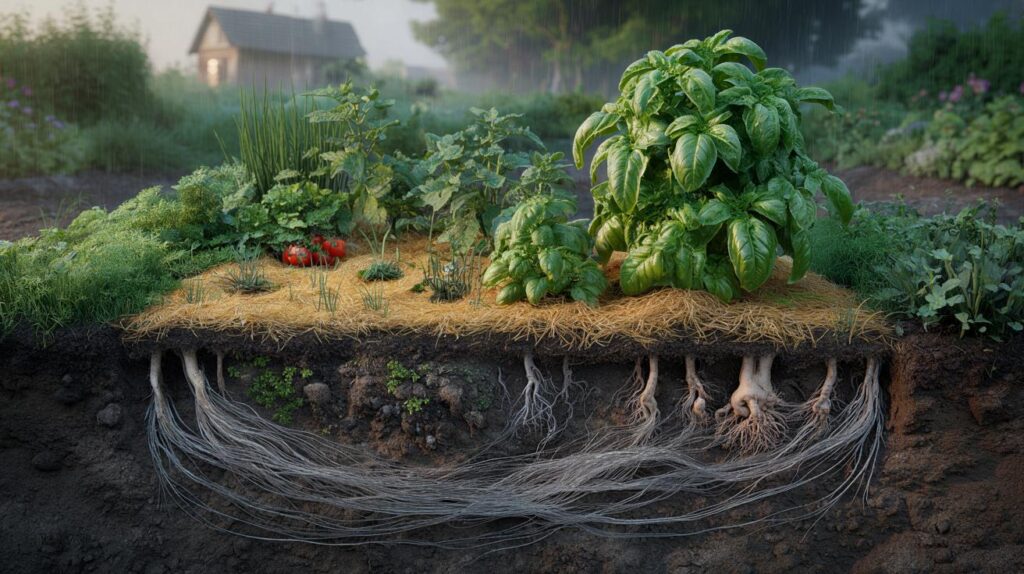
Under that surface, though, there’s a hidden network pulsing with activity. A quiet traffic of fungi and roots, trading sugars for minerals, moving nutrients from where they are to where plants need them most. This is not a rare miracle. It’s happening almost everywhere you see a plant clinging to life in tough ground.
A few weeks after that first chilly morning, Lena stopped pouring bags of fertilizer onto her beds and tried something different. She mixed in a little compost, but the big change was that she planted clover between her rows and left the roots of harvested plants in place.
By midsummer, the shift was obvious. Her tomatoes, once ghostly, had thick, dark leaves. The basil smelled stronger. Yield wasn’t just up; the whole plot looked calmer, more balanced. What surprised her most was that she hadn’t suddenly turned into a perfect gardener. She’d simply stopped fighting the soil and started letting the underground process she couldn’t see do its job.
That quiet process has a name: the mycorrhizal network. Fungi attach themselves to plant roots and spread fine filaments through the soil like a second root system. These filaments unlock nutrients stuck in tiny soil pores and deliver them to plants, even when the soil “tests” as low in available nutrients.
In return, plants feed the fungi sugars made from sunlight. This trade allows plants to grow in places that would look “poor” on paper. The soil doesn’t magically gain nutrients. The living network just uses what’s there far more efficiently, stretching every crumb of phosphorus, every droplet of nitrogen, every trace mineral that would otherwise stay out of reach.
How to support this quiet process in your own soil
The first gesture is almost disappointingly simple: stop disturbing the soil so much. That doesn’t mean never touching it, but easing up on deep tilling and aggressive digging. Every time the soil is turned over, parts of the fungal network are ripped apart, like tearing up cables in a house and expecting the lights to stay on.

Try working with a small hand fork instead of a shovel for regular maintenance. Add a thin layer of compost on top once or twice a year, rather than burying it. Plant roots will grow down into it, fungi will grow up into it, and that living border between old soil and fresh organic matter becomes a busy station of exchange. This is where the quiet magic scales up.
The second step is to never leave the soil naked for long. Bare ground dries out, bakes in the sun, and loses its living community fast. A light mulch of straw, shredded leaves, or even grass clippings gives fungi and roots a more stable home and protects the microscopic channels where water and nutrients travel.
We’ve all been there, that moment when you clear a bed “just for a week” and end up leaving it empty for the whole season. The soil crusts, weeds rush in, and next year everything feels harder. Let’s be honest: nobody really does this every single day. But even a rough cover, tossed on in ten minutes, can keep the underground network alive between crops.
When I asked a soil ecologist what single habit helps plants grow in lean ground, she didn’t hesitate.
“Feed the soil life, not the plant. The fungi know how to share better than we do.”
You can support that by adding a few simple anchors to your garden life:
- Plant at least one type of deep-rooted or perennial plant in each bed to host fungi year-round.
- Use diverse crops and cover plants, not the same single species over and over.
- Keep a living root in the ground as many months of the year as you can.
- Add small, regular amounts of organic matter instead of one massive nutrient shock.
- Avoid strong chemical inputs that burn through soil microbes and fungal threads.
These gestures don’t sound spectacular. Yet they are exactly what allows that hidden network to keep feeding your plants when the nutrient numbers on a lab sheet look discouraging.
Rethinking what “poor soil” really means
Once you’ve seen thin, chalky soil host a patch of vigorous wildflowers, it becomes hard to use the words “good” and “bad” soil the same way again. Some ground is genuinely exhausted, compacted, or contaminated, yes. Yet a lot of what gardeners call “poor soil” is simply under-connected soil, where the fungal network has been broken too often to do its quiet work.
*The question shifts from “How do I add more?” to “How do I help what’s already there move better?”* That shift doesn’t just change the look of your garden. It changes your relationship with time. You start seeing seasons as partners in a long conversation, not battles to win before autumn. You might still buy fertilizer, use compost, and fuss over your plants. But the real trust begins to settle not in the bag you carry, but in the living soil under your feet.
| Key point | Detail | Value for the reader |
|---|---|---|
| Mycorrhizal networks boost growth | Fungi extend root reach and unlock bound nutrients even in low-fertility soils | Explains why plants can thrive without heavy fertilizing and guides smarter care |
| Gentle soil handling protects life | Less tilling, more mulching, and shallow disturbance keep fungal threads intact | Offers practical steps that improve yields and soil health over time |
| Living roots keep systems active | Cover crops and perennials host fungi all year and stabilize nutrient flow | Helps readers design gardens that stay productive in tough conditions |
FAQ:
- Question 1Can plants really grow well in low-nutrient soil just by relying on fungi?
- Question 2Do I need to buy commercial mycorrhizal products for my garden?
- Question 3How long does it take for the soil network to recover once I stop tilling?
- Question 4Will mulch and cover crops attract pests or create more work?
- Question 5Can this approach work on a balcony or in containers, not just in the ground?
