
While the show floor obsessed over incremental gadgets, a small American start-up rolled out a superconducting electric motor that could redraw the map for aircraft, data centres and heavy industry. It looks unassuming, but its design tackles the single biggest headache that has blocked superconductors from leaving the lab and boarding a plane.
A superconducting dream finally meets practical engineering
Superconductivity has long sat on the edge of aviation fantasy. In a superconductor, electrical resistance drops to almost zero. Current flows without wasting energy as heat. On paper, this allows machines that are lighter, smaller and far more efficient than today’s best electric motors.

For aircraft, that changes the equation. Weight dominates every design choice. If you can cut motor mass while raising power, you gain range, payload or both. Superconducting machines can also generate much stronger magnetic fields, which means more torque from a smaller footprint. That is exactly what electric regional aircraft, hybrid airliners and eVTOL concepts crave.

Reality, until now, refused to cooperate. Superconductors need to be cooled to extremely low temperatures. Traditional systems use bulky cryogenic equipment: tanks, pumps, fluid lines, heat exchangers. Putting that plumbing into an aircraft wing or nacelle turns into a packaging and maintenance nightmare.

This new CES 2026 demonstrator doesn’t just use superconductivity; it bundles the entire cryogenic ecosystem inside the motor itself.
US start-up Hinetics brought to Las Vegas an integrated superconducting motor that aims to break this deadlock. No external cryogenic plant. No liquid tanks strapped nearby. From the outside, it behaves like a compact industrial machine. All the exotic cooling gear hides inside the casing.
A “thermos bottle” motor that carries its own cold
Hinetics’ core idea sounds deceptively simple: design the motor around its cooling, not the other way round.
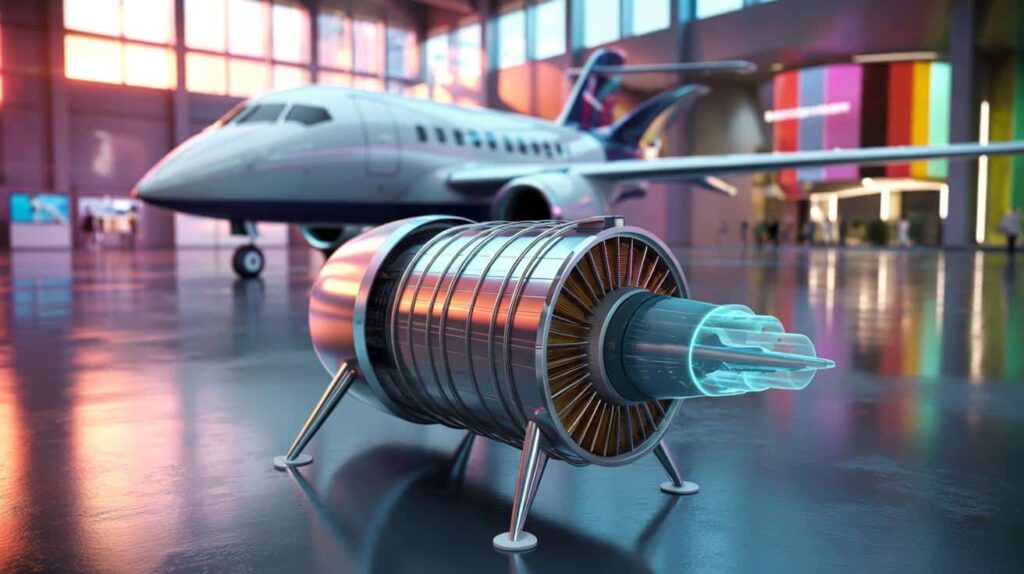
Inside the motor, superconducting coils sit in a high-quality vacuum. They hang from Kevlar supports that barely conduct heat, while multiple layers of aluminised mylar wrap the assembly, like an ultra-precise thermos. At the centre, a compact internal cryocooler reaches temperatures near −224 °C and pulls heat away through a so‑called “cold finger”.
The result: cold stays locked where the superconducting coils live, and warmth from the outside world struggles to leak in. Instead of piping cryogenic fluids back and forth, the cooling unit rides with the rotor.
By enclosing the rotor and cryocooler in one sealed vacuum chamber, Hinetics turns a lab setup into something you can bolt into a nacelle or generator room.
That shift from external infrastructure to self-contained module is what excites aviation engineers. Integration becomes far easier. Airlines and maintenance teams do not need to become cryogenics specialists. From their perspective, the motor looks like another high-performance electric machine with slightly unusual operating conditions.
Efficiency that matters at megawatt scale
The demonstrator Hinetics showed at CES delivers only a few kilowatts, but the company’s target is a 6‑megawatt superconducting motor for aircraft propulsion and grid applications.
At that scale, efficiency gains start to bite. Hinetics reports a target efficiency of around 99.5%. On a small lab bench, that sounds like nitpicking. On a 6 MW motor, shaving off just 0.5 percentage points of losses means hundreds of kilowatts that do not turn into unwanted heat.
Less heat means lighter cooling hardware, thinner cables and less structure to carry everything. The motor can shrink while its output stays high. Hinetics claims torque density roughly ten times that of conventional machines, with magnetic fields two to three times stronger than standard designs.
- Target power: 6 MW class
- Reported efficiency goal: ~99.5%
- Torque density: up to 10× conventional motors
- Magnetic field strength: 2–3× higher
- Speed capability: around 1,800 rpm
For aircraft designers, that combination suggests slimmer nacelles, lower drag and more room for batteries or fuel. In hybrid-electric concepts, a superconducting motor could pair with a gas turbine, allowing the turbine to run at its optimal point while the electric side handles peaks, climb phases and redistribution of power.
Built for aircraft, pitched to data centres
Aviation may be the poster child, but it is not the only market Hinetics has in mind.
Data centres, especially those aimed at artificial intelligence workloads, suffer from savage swings in power demand. As racks ramp up neural network training, load on the grid can spike in milliseconds. Traditional mechanical generators and many power electronics systems respond sluggishly or require complex buffer systems.
Hinetics emphasises that its motor has very low inductance and can react almost instantly to changes in electrical load. In a grid-support or back-up role, that fast response lets the system absorb or supply power variations directly through the mechanical shaft.
Fast electrical response turns the motor into a kind of shock absorber between erratic AI data centres and a grid that prefers calm, predictable demand.
Instead of stacking batteries, capacitor banks and control hardware, operators could use a superconducting machine in combination with a flywheel or engine, trimming the layers of complexity. For utility companies facing clusters of hungry AI facilities, that kind of tool could help stabilise voltage and frequency without overbuilding entire substations.

Three years of R&D squeezed into a small demonstrator
The unit at CES is not a product yet. It is a one‑twentieth scale engineering demonstrator of a future 3 MW machine now in development. The company’s goal is not to showcase raw power, but to validate the whole stack: vacuum enclosure, internal cryocooling, mechanical stability at speed, magnetic performance and thermal insulation.
The US energy agency ARPA‑E backs the project. ARPA‑E typically funds risky technologies with potential to transform energy use or cut emissions, and often supports ideas that big industry considers too early-stage.
An earlier prototype, nicknamed “Baby Yoda”, marked a turning point back in May 2025. Using a commercial Stirling cryocooler—essentially off‑the‑shelf hardware—Hinetics proved it could keep superconducting magnets at around −224 °C in a compact setup. That small test bench quietly removed a thermal roadblock that had stalled bigger ambitions.
Cost, not physics, as the main constraint
The physics works; the main question now is price. The most expensive ingredient is the superconducting tape, thin ribbons of advanced material that carry enormous current without resistance.
Hinetics notes that prices for these tapes have already halved in roughly three years, and suppliers project another halving within the next three. As factories scale up and yield improves, superconductors shift from exotic national-lab tools to components that can sit in catalogues alongside copper and standard magnets.
If superconducting tape prices keep sliding, designs that once looked like science projects start to make sense in aviation, shipping and grid equipment.
Initially, the technology will likely focus on niches where power density and efficiency justify higher upfront cost: regional aircraft, high-performance military platforms, offshore wind generators, and grid stability units in dense urban areas.
What superconductivity actually means for an aircraft
For non-specialists, terms like “torque density” and “megawatt electric propulsion” can feel abstract. A simple scenario helps.
Imagine a future 40–60 seat regional aircraft using two 6 MW superconducting motors. Compared with today’s state-of-the-art electric machines, designers might save hundreds of kilograms per motor. That weight can turn into extra battery capacity, more passengers or longer range.
Higher efficiency reduces waste heat near the wing, easing thermal management and potentially cutting the size of radiators and coolant loops. That matters in cruise, where excess drag from cooling systems can nibble away at range.
On the ground, airports could pair such aircraft with renewable-heavy microgrids. Highly efficient motors draw less electricity per flight, easing demand on infrastructure already strained by fast chargers, ground vehicles and terminal buildings.
Key terms worth unpacking
Two ideas come up repeatedly in this technology and tend to confuse readers:
- High-temperature superconductor: The phrase sounds like these materials operate at warm conditions, but “high” here only means “higher than conventional superconductors”. They still need temperatures well below −200 °C, just not the near‑absolute-zero levels required by early superconducting materials.
- Cryocooler: Instead of using liquid nitrogen or helium from tanks, a cryocooler works more like a miniature refrigerator. It compresses and expands a gas in cycles to pump heat away and reach extremely low temperatures, all within a sealed machine.
Both concepts underpin Hinetics’ motor. The choice of high-temperature superconductor eases the cooling burden, and the integrated cryocooler removes the need for complex fluid-handling infrastructure.
Risks, hurdles and what comes next
Plenty can still go wrong. The cryocooler must operate reliably for thousands of hours under aircraft vibration. Vacuum seals must survive repeated temperature cycles and mechanical loads. Certification agencies will want extensive data on failure modes: what happens if cooling drops out mid‑flight, or if the superconductor briefly leaves its superconducting state, a phenomenon called quenching.
There is also a supply-chain question. Superconducting tape production remains concentrated among a small group of companies. Rapid growth in demand from grids, wind turbines or military systems could create bottlenecks, pushing prices back up.
Yet the trajectory looks clear. As costs fall and engineering teams gain experience, superconducting motors are likely to creep in first at the edges—demonstrator aircraft, experimental generators, specialised grid equipment—before turning into routine choices for high-power electric platforms.
For the electric aviation community, which has struggled with battery limitations and range anxiety, the motor shown at CES 2026 does not magically solve everything. It does, though, remove one of the thorniest obstacles: how to carry superconducting performance into the sky without dragging along a laboratory’s worth of cryogenic hardware.
