
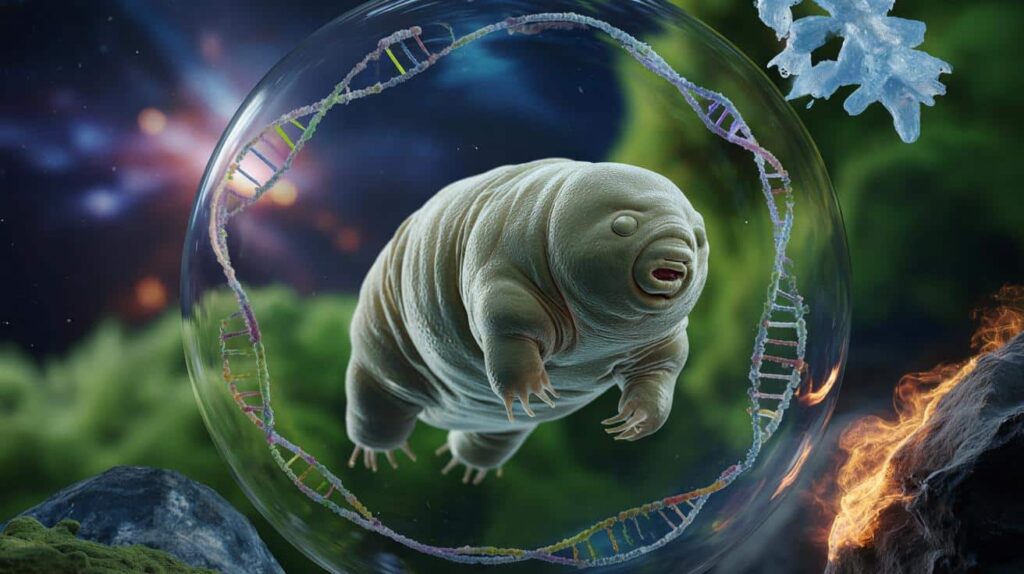
Tardigrades, sometimes nicknamed water bears, have fascinated scientists for years with their freakish toughness. Now, genetic research is revealing that part of their near-indestructibility may come from genes they “borrowed” from other species over hundreds of millions of years.
A tiny animal that refuses to die
Tardigrades are microscopic invertebrates, usually between 0.1 and 1 millimetre long. Under a microscope, they look a bit like eight-legged gummy bears, slowly trundling through droplets of water.

Despite their cuteness, their survival record is brutal. They can tolerate temperatures close to absolute zero, down to around −272 °C. At the other extreme, they endure brief exposure to about +150 °C. They also survive pressures roughly 6,000 times greater than those at Earth’s surface, far beyond what the human body could stand.

These animals have already outlived at least five mass extinctions, including the cataclysmic event 250 million years ago that nearly reset life on Earth. They have survived direct exposure to the vacuum of space, intense ultraviolet and X-ray radiation, extreme dehydration and even shots from laboratory guns in impact tests.
 Hairstyles after 50: this cut that was very trendy in the 60s is coming back into fashion in 2026
Tardigrades are not just tough; they stretch the limits of what biologists thought animal life could withstand.
Cryptobiosis: life in slow motion
The secret weapon of tardigrades is a state called cryptobiosis. In this condition, the animal essentially shuts itself down. It dries out almost completely, curls into a tiny ball and waits.
In cryptobiosis, standard signs of life vanish. Metabolism drops to near zero. Electrical activity is undetectable. Under a microscope, the animal appears inert, more like a grain of dust than a living organism.
Some species can shrink to around 38% of their normal volume as they dehydrate. Their cells rearrange and form protective structures, stabilising vital molecules and shielding DNA from damage. When water returns, the animal rehydrates and, astonishingly, “wakes up” and carries on as if nothing happened.
Not all tardigrades use exactly the same tricks. Different species show different degrees of shrinkage and resilience. That variation suggests that these creatures may have evolved several molecular toolkits to survive environmental stress.
Genetic scavengers: how tardigrades built their toolkit
The first full genome sequences of tardigrades appeared in 2016. Since then, teams around the world have been trying to match their bizarre abilities to specific genes.
Some of those genes look familiar. Others do not match anything seen in animals so far. Geneticists suspect that a portion of the tardigrade genome comes from other organisms, absorbed through a process called horizontal gene transfer.
Horizontal gene transfer is a genetic shortcut, allowing an animal to grab useful DNA from bacteria, fungi or other life forms instead of waiting for slow, incremental mutations.
In 2024, a Franco-Japanese team reported a new tardigrade species in the journal PLOS ONE. Their analysis suggests this species acquired a gene from a bacterium that helps it endure doses of X-ray radiation that would shred the DNA of most animals.
That is only one example. Researchers estimate that tardigrades have been on Earth for roughly 600 million years. Over that timeframe, they may have absorbed genetic material from a wide range of organisms, many of which are now extinct. Those vanished donors make large parts of the tardigrade genome very hard to trace.
Strange genes with powerful effects
Among the genes that scientists have identified, several carry technical but memorable names: SAHS, MAHS, TDPs, LEA, Doda1, Trid1 and CAHS, among others.
Researchers have taken some of these genes and inserted them into cells from other species, including human cells, plants, yeasts and bacteria. The results are striking. The modified cells tolerate higher levels of X-rays, ultraviolet light and strong oxidants than normal.
When tardigrade genes are transplanted into other organisms, the recipient cells gain a noticeable boost in resistance to damage.

To give a clearer sense of what these genes may do, scientists broadly group their roles as follows:
- TDPs (tardigrade disordered proteins): help protect cellular structures during extreme drying.
- LEA proteins: originally known from plants, guard proteins and membranes when water is scarce.
- CAHS/SAHS/MAHS families: appear to stabilise cells under stress such as radiation or dehydration.
- Doda1 and Trid1: candidates linked to DNA or protein protection, still under investigation.
From space-proof animals to next‑generation medicine
The practical implications of this research extend well beyond zoology. If the mechanisms behind tardigrade resilience can be harnessed, they might protect sensitive products or even human tissues.
One immediate target is vaccine storage. Many vaccines and biological drugs must be kept cold from factory to patient, a constraint known as the cold chain. In poorer or remote regions, maintaining this chain is expensive and unreliable.
By mimicking tardigrade-style protection, pharmaceutical companies could one day ship vaccines that tolerate drying and heat, without relying on bulky freezers.
In the lab, some teams are already testing whether tardigrade proteins can preserve enzymes, antibodies or whole cells when they are dried and later rehydrated. If that approach works at scale, it could change how blood products, probiotics and even engineered tissues are stored.
Why horizontal gene transfer matters for evolution
Horizontal gene transfer is common in bacteria, which regularly swap DNA through plasmids or viruses. In animals, it is rarer but increasingly recognised.
For tardigrades, picking up foreign genes may have acted like a fast-track innovation system. Instead of slowly evolving completely new proteins, they could integrate existing solutions developed by microbes or other organisms already adept at handling stress.
This challenges the traditional picture of evolution as strictly vertical, passing genes from parent to offspring. Tardigrades suggest that, at least for some lineages, evolution also pulled sideways, borrowing and remixing ready-made tools.
Key terms that help make sense of tardigrade research
The science around tardigrades and their genes uses a vocabulary that can sound abstract. A few core concepts clarify the discussions:
| Term | Meaning |
|---|---|
| Extremophile | An organism that thrives in conditions that are lethal to most life, such as intense heat, cold, pressure or radiation. |
| Cryptobiosis | A reversible state where metabolism almost stops, allowing survival through extreme stress like drying or freezing. |
| Horizontal gene transfer | Movement of genes between species, not just from parent to offspring. |
| Oxidant | A reactive chemical that can damage DNA, proteins and cell membranes. |
Future scenarios: from space missions to climate resilience
Tardigrades already spend time in orbit as test passengers. Space agencies use them to gauge how life responds to cosmic radiation, microgravity and vacuum. With a better grasp of their genetics, future missions could test how tardigrade-inspired molecules protect biological samples on long journeys, such as to Mars or the outer planets.
On Earth, rising temperatures and more frequent droughts are putting pressure on crops. If some tardigrade genes or similar mechanisms can be adapted safely to plants, agriculture might gain varieties that stay viable longer in dry soil or store better after harvest. Any such move would raise regulatory and ethical questions, but the basic biology is already under active study.
Risks, limits and realistic expectations
Talk of “almost immortal” animals can sound like science fiction, and that framing risks confusion. Tardigrades can die; they are not eternal. Their longevity comes from a combination of resilience and tiny size, not magic.
There are also clear limits to applying their tricks to humans. Flooding our cells with foreign protective proteins could trigger immune problems or disrupt normal processes. For now, the most promising uses lie in protecting molecules, cells or simple organisms, rather than reengineering whole people.
Still, tardigrades show that life can stretch far beyond usual boundaries. By picking up outside genes and turning them into a survival kit, these microscopic animals have written one of evolution’s most resilient stories. Scientists are only starting to learn how to read it, and how to reuse a few of its cleverest lines.
