
Friday afternoon, hair salon packed, raincoats hanging on every chair. In the mirror, between a teenager’s curtain bangs and a 30-something’s slick bob, a woman in her fifties stares at her reflection and sighs. “I want something fresh, but I don’t want to look like I’m trying to be 25,” she tells the hairdresser.
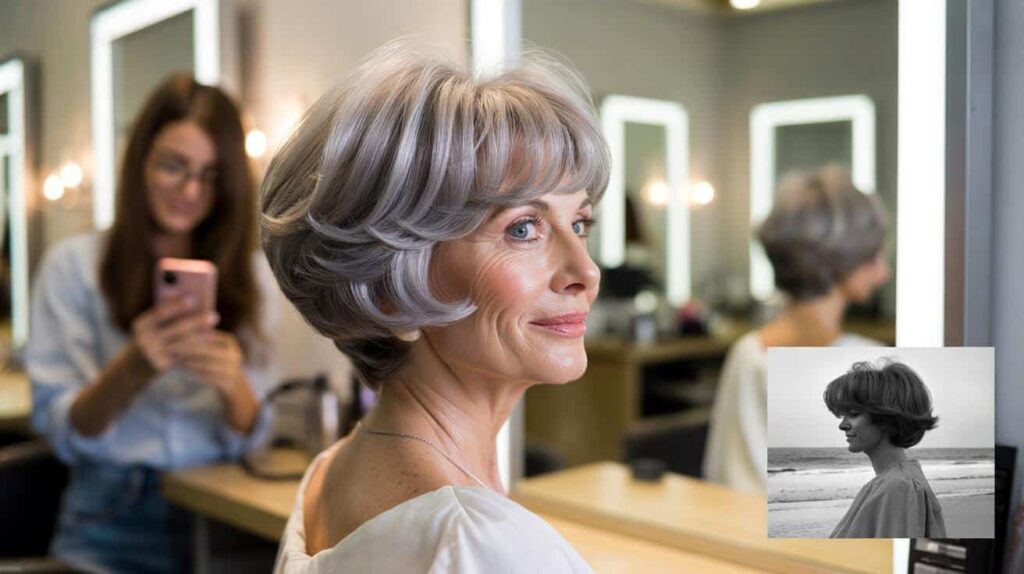
The hairdresser smiles, pulls out an old-look mood board on her tablet, and swipes to a black-and-white photo from the 60s. Rounded volume, soft sides, fringe that flatters the eyes. The client’s face lights up. “My mother wore her hair like that,” she whispers. “On New Year’s Eve.”

Two hours later, she leaves with a modern version of that cut from the photo. Strangely chic. Familiar and ultra-current at the same time.

This 60s hairstyle is quietly staging its comeback for 2026.

The surprising comeback of the 60s shaggy bob after 50
Walk into any trendy salon right now and look closely: between the classic long layers and the standard short bob, a very specific shape is sneaking back in. A rounded, mid-length cut that hits around the jaw or just below, with soft layers and easy volume. Think 60s shaggy bob, but lighter, freer, less “helmet”, more movement.
On women over 50, the effect is striking. Cheekbones pop, neck looks longer, jawline seems firmer. It doesn’t scream “I just copied a TikTok trend”. It whispers something else entirely: I know who I am, and I’m allowed to have fun.
This isn’t an isolated Pinterest fantasy. French salons are already reporting a rise in demand for retro-inspired shapes, and stylists in London and New York are posting side-by-side photos: 1967 versus 2025, same idea, softer finish.
One London stylist describes it as “the cut that lets grey hair look intentional, not accidental”. On Instagram, you see 54-year-olds documenting their “post-career promotion haircut” and 62-year-olds showing before/after photos where heavy, long hair suddenly becomes light and bouncy.
We’ve all been there, that moment when your hair starts feeling like a costume from a life that doesn’t quite fit anymore. This is where the 60s shaggy bob slips in and quietly resets the story.
Why this cut, and why now? Because faces change after 50, but the old rules of “don’t go too short, don’t go too bold” are collapsing. The 60s shaggy bob hits a rare sweet spot. It frames the face without hard lines. It carries volume without begging for a round brush boot camp every morning.
Let’s be honest: nobody really does a full blow-dry routine every single day. That’s where this shape wins. Soft layers help hair fall into place even when you just air-dry. The 60s gave us the outline. 2026 brings the texture, the airiness, the relaxed French-girl finish. *Same spirit, different era.*
How to adapt the 60s shaggy bob to a post-50 face
The starting point is simple: length at or slightly below the jaw, with rounded edges. Ask your hairdresser for a bob with soft, internal layering and a “broken-up” finish on the ends. The goal isn’t a perfect bubble; it’s a gentle oval that follows your cheekbones.
If you’re nervous, start a little longer, just above the shoulders, and let your stylist remove weight bit by bit. Ask them to cut more when the hair is dry, so the movement you see in the mirror is real, not theoretical.

For fringe, think 60s but updated: curtain bangs or a light, eyebrow-skimming fringe that can split in the middle. This instantly softens forehead lines and brings attention back to the eyes without feeling like a hard curtain.
The biggest trap past 50 is confusing “easy to live with” and “flat”. The modern 60s shaggy bob lives in the middle: not demanding, not lifeless. The mistake many of us make is asking for a blunt, one-length bob “to keep it simple” and ending up with a heavy block that drags the face down.
On the opposite extreme, too much layering can expose thinning areas or make hair look frayed. This is where an honest conversation with your stylist matters: talk about your real routines, your patience level, your texture.
Be gentle with yourself, too. Hair changes with hormones, stress, medication. You’re not “doing it wrong”; you’re adapting to a new version of you.
“Women in their fifties come in apologizing for their hair,” says Claire, 48, salon owner in Lyon. “I tell them: you don’t need to apologize. Your hair just needs a different story. The 60s bob works because it says ‘grown woman’ and ‘playful’ in the same sentence.”
- For fine hair: ask for minimal, strategic layers on the top and around the face, plus a slightly shorter back to create lift at the crown.
- For thick or wavy hair: request internal thinning rather than short layers on top, so the cut keeps shape without turning into a triangle.
- For grey or salt-and-pepper hair: pair the cut with soft highlights or lowlights around the face to mimic the light-play of 60s film photos.
Hair after 50: more than a cut, a quiet statement
Something interesting happens when this 60s-inspired cut lands on a 2026 woman’s head. It’s not just about inches lost or layers gained. It’s about permission. Permission to stop hiding behind heavy lengths worn “just in case”, permission to stop chasing the same beach waves as your daughter, permission to inhabit your own era without feeling parked in the past.
The women who wear this shaggy bob best aren’t trying to look younger at all costs. They’re trying to look awake. Present. Aligned with the life they actually live now, with early-morning walks, care work, Zoom meetings, and dinners where reading the menu requires good lighting and zero shame.
What’s fascinating is how quickly the cut rewrites posture. You see shoulders straighten, heads tilt slightly higher, smiles last a beat longer. A hairstyle can’t fix everything, of course. But when the mirror stops arguing with your age and starts collaborating with it, something unclenches.
This 60s cut returns in 2026 with all its quiet drama, but the message has changed. Back then, it said “modern housewife, magazine-ready”. Today, it says: I’m not done evolving. I can change my hair at 55, at 63, at 71, and it’s not a crisis. It’s just another season.
Maybe that’s why the trend resonates so strongly on social media, especially among women who never saw themselves as “hair people”. It’s a retro shape that doesn’t require a retro life. You can wear it with sneakers, with bifocals, with silver roots, with red lipstick. You can grow it out again next year.
The real revolution might be this: we’re slowly dropping the idea that past 50, hair choices should be about disappearing, softening, blending in. The 60s shaggy bob, reborn and slightly imperfect, gently pushes the opposite idea. That you’re allowed to be visible. Even from behind, in the supermarket line.
| Key point | Detail | Value for the reader |
|---|---|---|
| 60s shaggy bob shape | Rounded jaw-length or slightly longer cut with soft layers and light fringe | Offers a clear idea to discuss with the hairdresser and adapt to each face |
| Adapted to mature hair | Works with fine, thick, wavy, or grey hair when layering is customized | Shows that the trend is accessible even with changing texture and volume |
| Low-effort styling | Cut designed to fall into place with air-drying and minimal products | Makes a modern, chic look realistic for everyday life after 50 |
FAQ:
- Is the 60s shaggy bob suitable if I have a round face?Yes, as long as the volume is slightly higher at the crown and the sides are softened rather than puffed out. Ask for longer pieces around the face and avoid a fringe that cuts straight across mid-forehead.
- Can I wear this cut with naturally curly hair?Absolutely, but the balance of layers is crucial. Your stylist should cut curl-by-curl or on dry hair, keeping the shape rounded without creating a mushroom effect. A bit of curl cream and air-drying can be enough.
- What if my hair is thinning on top?Then the goal is lightness, not more cutting. A slightly shorter back, soft layers at the crown, and a wispy fringe can camouflage sparse areas without exposing the scalp. Ask for point-cutting instead of harsh, straight lines.
- Do I need bangs for this look to work?No, but a soft fringe or long curtain bangs really enhance the 60s spirit. If you’re unsure, start with longer face-framing pieces that can be pushed back or styled as a pseudo-fringe on days you feel like it.
- How often should I trim this kind of cut?Every 6 to 8 weeks keeps the shape alive without feeling high maintenance. If your hair grows slowly, you can stretch to 10 weeks and ask for micro-adjustments rather than a full reshape each time.
